Brass Audition Requirements for MM
Applicants will be notified if they advance to the audition round to perform on campus. Live auditions are recommended. If you are unable to schedule a live audition, you may submit video audition recordings. Applicants invited to audition will be considered for scholarships and graduate assistantships. All auditions must be completed by February 20. Submit applications by Dec. 1 for priority scholarship and assistantship consideration.
Trumpet
- Two solo works from contrasting style periods.
- Orchestra excerpts to demonstrate knowledge of standard orchestral literature.
- One etude from Charlier or etude of comparable level.
- Students are encouraged to demonstrate abilities on other trumpets – C, E-flat or piccolo trumpets.
- If a student has other performance skills such as jazz improvisation and/or lead playing, he/she is encouraged to demonstrate these talents also.
For questions regarding specific audition repertoire, contact:
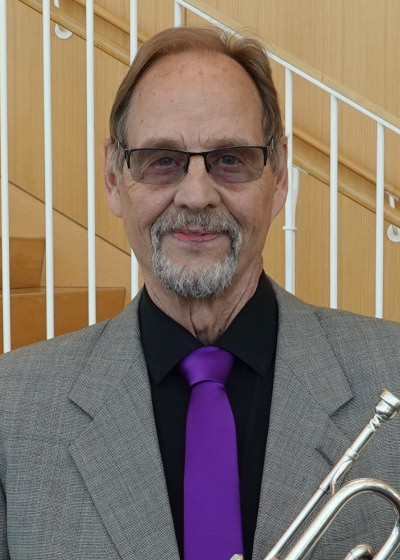
For questions regarding specific audition repertoire, contact:
French Horn
- Play one solo comparable in difficulty to:
- Hindemith- Sonata for Horn
- Strauss- Concerto No. 2
- Dukas- Villanelle
- Play one étude comparable in difficulty to etudes found in any of the following étude
books:
- Gallay
- Kling
- Maxime-Alphonse
- Bitsch
- Chaynes
- Neuling
- Play three orchestral excerpts from the following list:
- Beethoven – Symphony No. 7 (1st movement, mm. 84-101, horn 1 OR horn 2)
- Brahms – Symphony No. 3 (3rd movement, horn 1)
- Strauss – Till Eulenspiegel (opening call)
- Shostakovich – Symphony No. 5 (low tutti)
- Tchaikovsky – Symphony No. 5 (2nd movement, horn 1)
- Wagner – Gotterdammerung (Siegfried’s Rhine Journey, short call)
- Play all major scales and selections from the three forms of all minor scales. All scales must be played from memory.
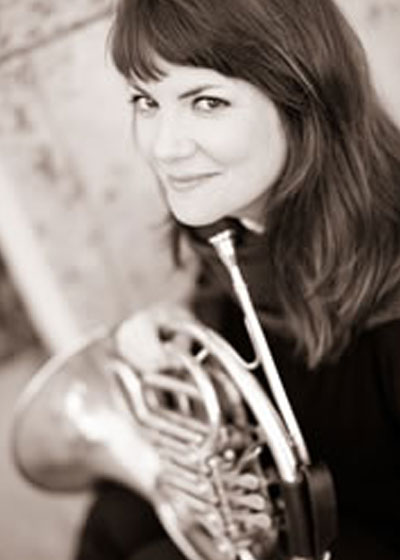
For questions regarding specific audition repertoire, contact:
Trombone
Tenor Trombone
- Play one étude comparable in difficulty to:
- Rochut: Book I, #55- 60
- Bitsch: 15 Etudes de Rythme, Etude #3
- Boutry: 12 Etudes de haut Perfectionnement, Etudes #7
- Play one solo comparable in difficulty to:
- Grondahl – Concerto
- Larsson – Concertino
- Sulek – Sonata vox Gabriel
- David – Concertino
- Play five orchestral excerpts comparable in difficulty to:
- Mozart: Tuba Mirum from Requiem
- Berlioz: Hungarian March (2nd trombone part)
- Rossini: La Gazza Ladra Overture
- Wagner: Ride of the Valkyries
- Ravel: Bolero
- Students with skills in jazz improvisation and/or ballad playing are encouraged to showcase their talents.
Bass Trombone
- Play one étude comparable in difficulty to:
- Naulais: 18 études pour trombone basse Contemporary
- Rochut: Volume I (#49-60 played 8vb)
- Maenz: Zwanzig Studien fur Bassposaune
- Play one solo comparable in difficulty to:
- Bozza – New Orleans
- Lebedev – Concerto in One
- Sachse – Konzert (ed. Arno Hermann)
- Koetsier – Allegro Maestoso
- Play five orchestral excerpts comparable in difficulty to:
- Haydn: Achieved is the Glorious Work from The Creation
- Berlioz: Hungarian March
- Schumann: Symphony No. 3, “Rhenish”
- Rossini: William Tell Overture
- Wagner: Entry of the Gods into Valhalla from Das Rheingold
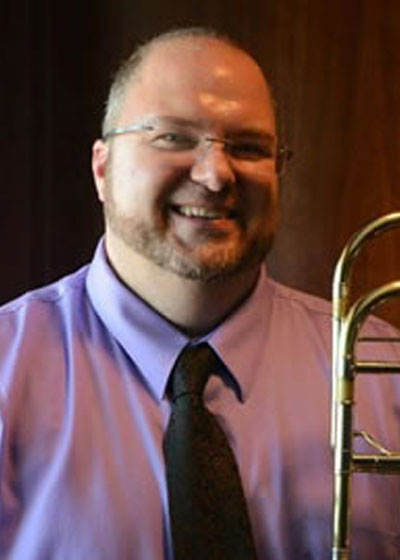
For questions regarding specific audition repertoire, contact:
Euphonium
- Two contrasting solo selections (with or without piano accompaniment).
- Two excerpts from standard orchestra, band and/or jazz repertoire.
- Three contrasting solo works showcasing your abilities.
- Selections can include separate movements from a multi-movement work or different compositions.
- Études may substitute one solo if preferred
- Four excerpts of your choice from standard orchestra, band, and/ or jazz repertoire.
- Possible sight-reading.
- The length of the live audition is approximately 20 minutes.
For questions regarding specific audition repertoire, contact:
Tuba
- Two contrasting solo selections (with or without piano accompaniment).
- Two excerpts from standard orchestra, band and/or jazz repertoire.
- Three contrasting solo works showcasing your abilities.
- Selections can include separate movements from a multi-movement work or different compositions.
- Études may substitute one solo if preferred
- Four excerpts of your choice from standard orchestra, band, and/ or jazz repertoire.
- Possible sight-reading.
- The length of the live audition is approximately 20 minutes.
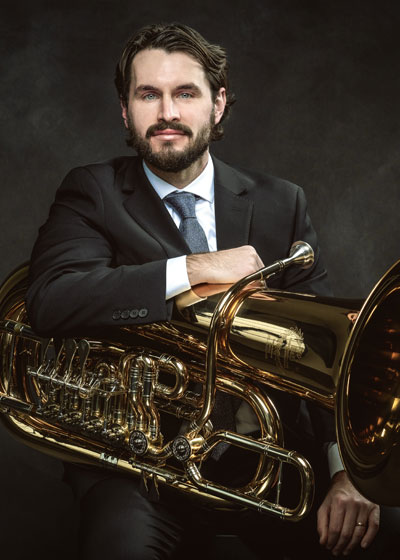
For questions regarding specific audition repertoire, contact:
Master of Music General Admission Requirements
Bachelor’s Degree: To be admitted to the MM/MME degree programs, students must possess a Bachelor of Music or its equivalent, with a major in the area of proposed graduate study, including sophomore-level credit in an approved foreign language in the case of prospective majors in musicology, theory, composition, voice, or voice pedagogy.
Academic Standards: For admission, the student must have satisfactory undergraduate preparation for the particular degree sought, which includes at least a “B” average (comparable to at least 3.0 on a 4.0 scale) in all undergraduate work and satisfactory scores on the appropriate tests required by the school/college.
International Student Requirements: A minimum TOEFL score of 4.5, a minimum IELTS score of 6.5, or a minimum Duolingo English Test score of 110 is required for admission. Test may be waived for students who hold undergraduate degrees from a university with English as the language of instruction. Test scores must be sent to TCU from the testing agency to school code: 6820. Official scores must be sent to TCU from the testing agency by the application deadline for the application to be considered “complete”. Applicants will not be invited to audition without official scores that meet the admission standards.
Exemption: Exemptions to this requirement are given if the student has completed (or will before matriculation to TCU) an undergraduate degree from a US institution or from a university where English is the language of instruction. To request consideration for this exemption, submit an official final or most current official in-progress transcript using the directions below and indicate an exemption request on the TCU graduate application when prompted. Translations must be provided for all international transcripts.
Fund Your Education
In addition to TCU’s full range of scholarships, the School of Music offers scholarships for creative performance.
State-of-the-Art Learning Facilities
Students have access to world-class venues and studios to launch successful careers in music and beyond.