
TCU Students Advance NASA-Inspired Wearable Technology Research
Interdisciplinary collaboration is helping TCU students solve NASA-inspired design challenges while preparing them for careers in research and innovation.
This year, undergraduate students from fashion merchandising, engineering and computer science worked together through the Texas Space Grant Consortium's Tech Collaboration Center (TCC) Wearables Workshop and Human System Design Workshop. Guided by faculty mentors, the teams tackled real-world challenges related to astronaut health, movement and spacesuit performance while gaining firsthand experience with research, design, prototyping and testing.
Rather than following a predetermined set of instructions, students researched existing technologies, identified opportunities for improvement, built prototypes and refined their designs through an iterative process of testing and evaluation.
For James Huffman, an engineering professor of professional practice in the Louise Dilworth Davis College of Science & Engineering, the workshops demonstrated why interdisciplinary collaboration is essential to solving complex problems.
“A solution to a real-world challenge is not just the integration of components,” Huffman said. “The overall design of a product needs many disciplines.”
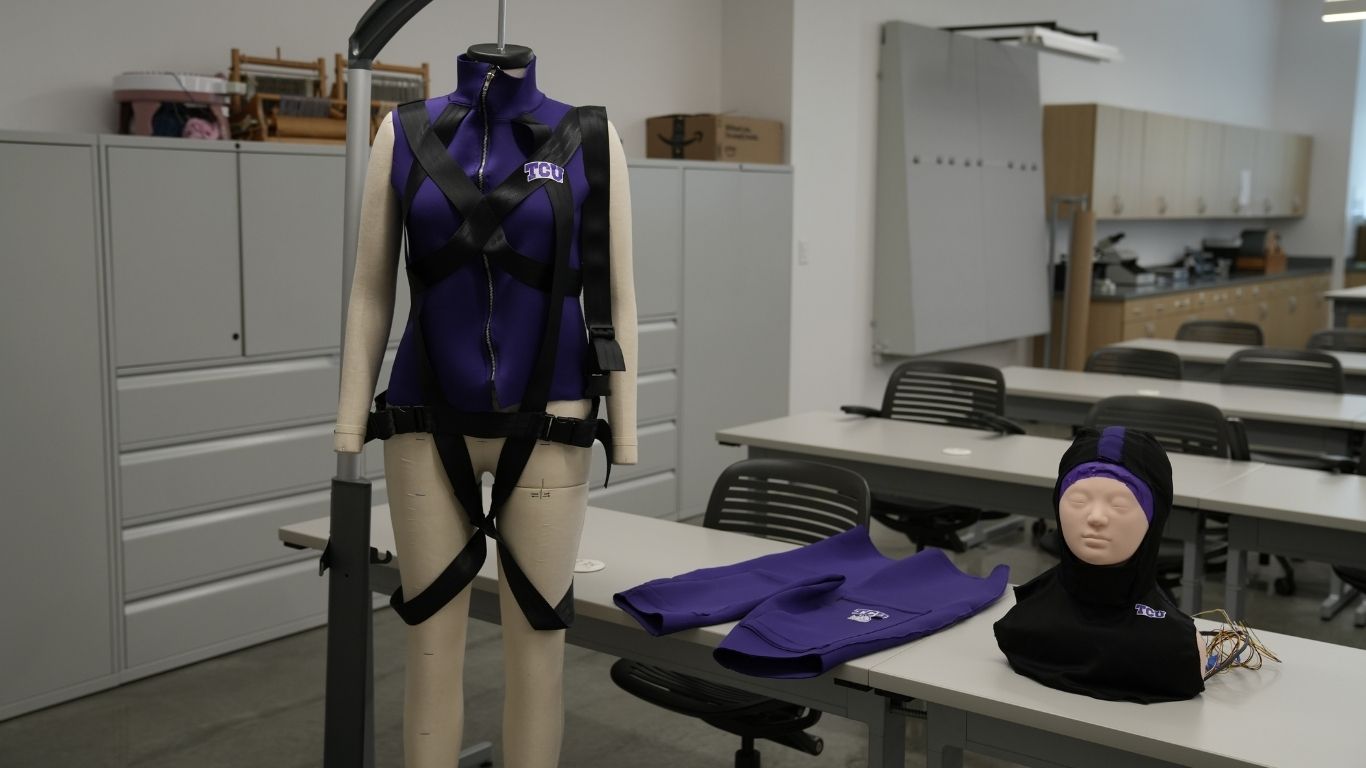
Monitoring Human Movement
One research team — Amarige Yusufji ’26, Daisy Li ’26, juniors MaryJane Mulligan,
Kiara Stefan and Mims Hammond and sophomore Katelyn Daigneau — developed a smart textile
garment capable of monitoring head and upper-body movement in real time.
The lightweight hood and vest securely integrate motion sensors into performance fabrics while maintaining comfort and mobility. The wearable system collects movement data that can be visualized through a live dashboard, providing insight into posture, head movement and body orientation. While designed with spaceflight in mind, the technology also has potential applications in rehabilitation, sports performance and human movement analysis.
For Daigneau, the interdisciplinary approach was one of the most valuable parts of the experience. Yusufji earned a double degree in combined science and French and was a student in the John V. Roach Honors College. Li was a biochemistry major, and Stefan is studying electrical engineering. Mulligan, Hammond and Daigneau are fashion merchandising majors.
“Every member of our group had different areas of strength, which helped shape the
design we created because none of us could have done it alone,” Daigneau said. “Seeing
everyone's ideas come together in the final prototype showed me how important collaboration
truly is.”
Improving Astronaut Mobility
A second team of fashion merchandising students — Adelaide Lovett ’26, seniors Emily
Noonan and Kalei'o Hernandez and juniors Caitlyn Heckman, Sydney Herr, and Zohie Lopez
— also brought diversity to the group. Lovett earned a second degree in psychology,
and Noonan is also majoring in marketing. This group focused on improving astronaut
visibility and comfort while seated in a lunar rover.
Students designed and tested two concepts — an inflatable lift system and a hammock-inspired support harness — to gently elevate astronauts wearing pressurized spacesuits. Through iterative prototyping and laboratory testing, both approaches demonstrated improvements in seated height and field of vision, offering potential solutions for future lunar exploration.
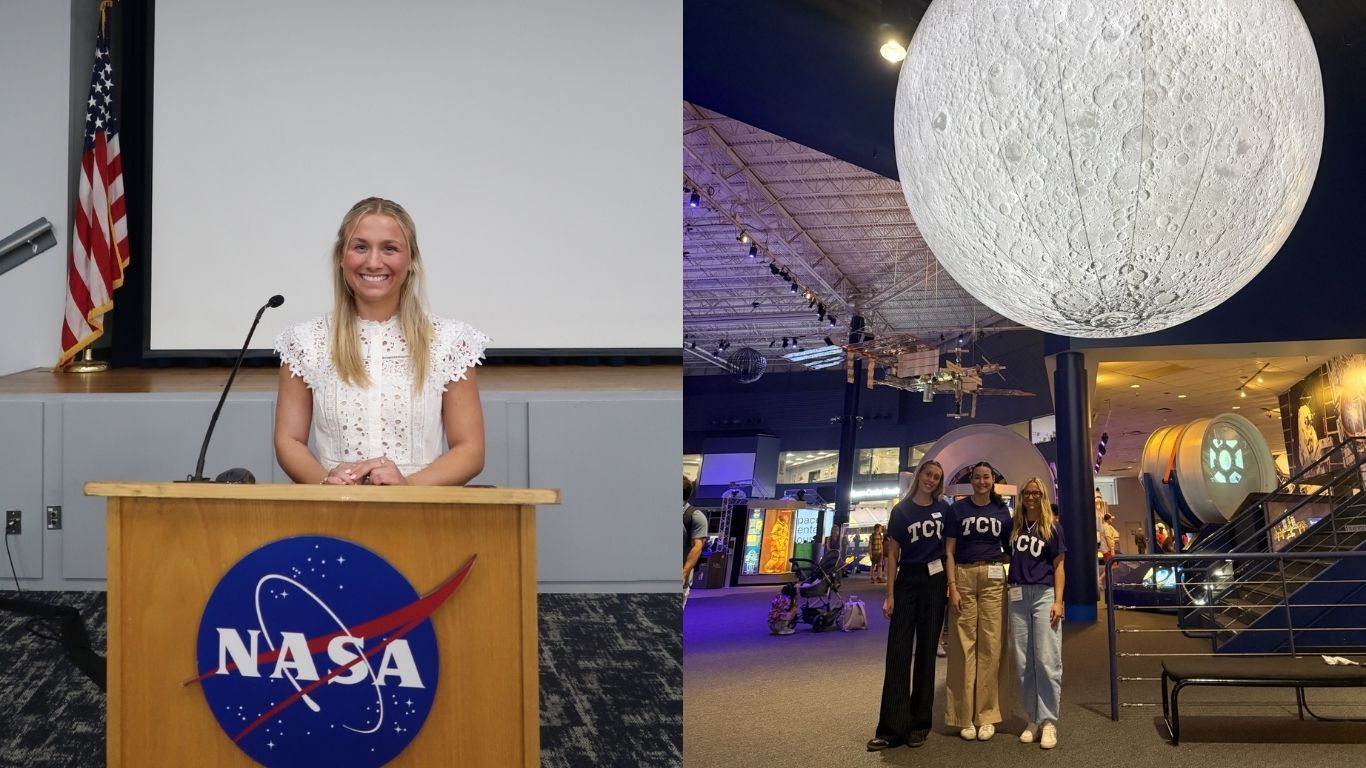
Learning Through Research
This was not TCU’s first rodeo with NASA. Last year, an interdisciplinary team of undergraduate students won the 2025 Best Innovation
Award for a design that addressed a critical issue facing spacesuits in lunar missions.
For Leslie Browning-Samoni, Instructor II in the Department of Fashion Merchandising, the greatest success of these missions aren’t simply the prototypes, it's watching students learn how research works.
“The goal isn't for students to solve NASA's challenge in a single semester,” Browning-Samoni said. “The goal is for them to experience how research really works. They learn to investigate what has already been done, ask thoughtful questions, test ideas, analyze results and use those results to improve the next iteration. Those are skills they'll carry with them throughout their careers.”
Together, Browning-Samoni and Huffman mentored students through every stage of the research process, helping them connect knowledge across disciplines while encouraging them to take ownership of their work.
“This experience has tremendously shaped my career goals and the way I think about design,” Daigneau said. “Participation in this project piqued my interest in the design and product development aspects of fashion. Working through the design process with a team also gave me a better understanding of what goes into developing a design.”
The projects demonstrate TCU's commitment to experiential learning and undergraduate research, showing how fashion, engineering and computer science can come together to address complex challenges with applications that extend far beyond the classroom.